
Chaos Crew slot review: how the bonus works and what the multipliers really do
Chaos Crew is a high-volatility slot from Hacksaw Gaming that is built around hooking multipliers into a single payout, rather than giving you lots of small features that blur together. If you’re looking at it in 2026, the game is still widely available in licensed casinos, and the core mechanics haven’t changed: multipliers in the base game, then a free spins bonus that “stores” multiplier values until the round ends.
Chaos Crew in 2026: what you’re actually playing
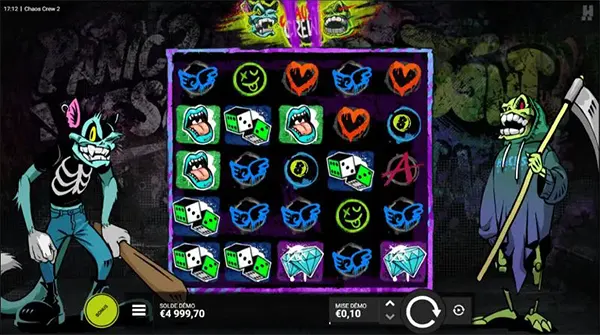
The game runs on a 5×5 grid with fixed paylines, and it’s designed to feel “swingy”: long quiet stretches can be followed by a hit that does most of the session’s work. The maximum advertised win is 10,000x your stake, which is the hard ceiling you’re playing for rather than a progressive jackpot.
One thing worth knowing up front is that operators can offer different RTP versions of the same slot. Chaos Crew is commonly listed with a 96.30% RTP setting, but lower configurations also exist, so the exact long-run return depends on where you play.
If you’re evaluating it for real money play, treat it like a variance test, not a “steady grinder”. That means choosing a stake you can repeat for a meaningful number of spins, because the game’s profile is built around rare, multiplier-heavy outcomes.
RTP, volatility, and why the paytable matters
In practical terms, volatility tells you how the game tends to distribute results: fewer “middle” wins, more emphasis on big spikes. With a high-volatility model, it’s normal to see sessions where the bonus doesn’t show up quickly, or where it triggers but lands on the lower end of outcomes.
Because RTP can be configurable, it’s worth checking the information panel or paytable inside the game you’re launching. If the casino is offering a reduced RTP variant, your expected return shifts, even though the visuals and features look identical.
Finally, remember that RTP is a long-run average across a very large number of spins. It doesn’t predict what you’ll get tonight, so sensible session limits and breaks are part of playing responsibly—especially with games that can encourage “just one more spin” thinking.
How multipliers work in the base game
The headline mechanic is the Cranky Cat symbol. When it participates in a win, it applies a multiplier to that win. More importantly, multiple Cranky Cat symbols can affect the same winning line, and their values can multiply together, which is where the base game’s best moments come from.
This creates a specific kind of risk/reward trade-off. A standard line win without a multiplier can feel modest, but a similar hit becomes meaningful if it catches one or more Cranky Cats. The game is essentially asking you to tolerate the quieter spins for the chance of a multiplied line outcome.
A sensible way to think about it is that the base game is not “featureless”; it’s just feature-light. You’re waiting for wins that are improved by multipliers, rather than collecting lots of small side mechanics that pay frequently.
What stacking multipliers means for your bankroll
Stacking is powerful because multiplication grows quickly. If two multipliers combine on the same win, you’re no longer adding value—you’re scaling it. That’s why the game can jump from ordinary results to a result that feels outsized relative to the stake.
The flip side is that you can’t plan for stacking on demand. You can only control your bet sizing and your session structure, not when the symbols land or whether they line up on a paying path at the same time.
For practical play, this is why many experienced players set a strict stop-loss and stop-win before they start. High-volatility slots can produce a tempting “chase” pattern, so having rules written down (even if it’s just a note on your phone) is often more useful than any spin-by-spin “strategy”.
The bonus round and Bonus Buy: step-by-step
Chaos Crew’s bonus is a free spins round that focuses on collecting multiplier values. During the feature, landed Cranky Cat and Sketchy Skull multipliers are stored above the reels as bonuses, and the round continues while you avoid running out of “lives” (three strikes ends it).
The key accelerator is the Epic multiplier symbol (the striped one). When it lands, it applies its value to all stored bonus symbols, which can dramatically change the final total. This is the part of the design that can turn an average bonus into a standout one.
When the bonus ends, the game totals the stored multiplier values and then multiplies that total by your wager to calculate the payout. Hacksaw also includes a Bonus Buy option in many casino versions, letting you pay an extra amount to enter the free spins round directly, but the cost and availability can vary by operator and jurisdiction.
How to read the bonus payout without guessing
The easiest way to follow the maths is to separate “collection” from “conversion”. During the bonus, you’re collecting multiplier values (and sometimes boosting them via Epic multipliers). At the end, the game converts the final multiplier total into money by applying it to your stake.
This structure explains why two bonuses that look similar can pay very differently. A run with several stored multipliers but no meaningful Epic boost may end up middling, while a bonus that lands an Epic symbol at the right time can inflate everything you’ve already banked.
If you use Bonus Buy, treat it like paying for variance, not paying for a guaranteed return. It can be entertaining, but it can also speed up losses if you buy repeatedly. A safer approach is to decide in advance how many bonus purchases you’ll allow (even if the number is one), and stop there—because the game’s volatility doesn’t become “friendlier” just because you entered the feature faster.
Read also
-
 all articlesClassic Three-Reel Slots vs Modern Video Slots: Choosing the Right Fit f...
Slot machines have evolved significantly over the past few decades, …
-
 all articlesFisherman’s Luck (Wazdan) — Analysis of the Slot’s Bonus Logic
Fisherman’s Luck by Wazdan is a fishing-themed slot released by …
-
 all articlesGalaxsys — Provider Review of Instant and Crash Games: What Players Shou...
Galaxsys is an Armenian game developer that has gained strong …
-
 all articlesGreat Rhino Megaways — a practical breakdown of Megaways maths and bonus...
Great Rhino Megaways is a high-variance safari slot built around …